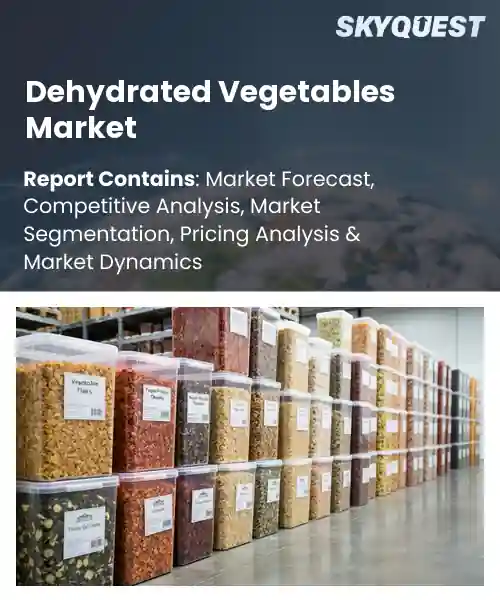
Dehydrated Vegetables Market
Report ID: SQMIG30H2372
Report ID: SQMIG30H2372
[email protected]
USA +1 351-333-4748
Report ID:
SQMIG30H2372 |
Region:
Global |
Published Date: February, 2026
Pages:
157
|Tables:
238
|Figures:
81


Global Dehydrated Vegetables Market size was valued at USD 8.7 Billion in 2024 and is poised to grow from USD 9.35 Billion in 2025 to USD 16.68 Billion by 2033, growing at a CAGR of 7.5% during the forecast period (2026-2033).
The demand for shelf-stable products that meet food security needs drives the global dehydrated vegetables market growth because consumers want accessible products, leading to a change in global manufacturing and distribution practices. Dried vegetables include all forms of onions, potatoes, carrots and tomatoes which food processors and restaurants and global exporters use because dried vegetables reduce spoilage and decrease transportation expenses and make inventory management easier.
The market plays a critical role because it supports the supply networks that deliver ready-made meals and seasonings and emergency food supplies, which evolved from sun-drying practices in agricultural societies to advanced industrial dehydration and freeze-drying operations, exemplified by instant soup bases and MRE systems. The development of dehydration technology combined with changing consumer tastes represents the primary driver of market growth because vacuum microwave drying and controlled-atmosphere dehydration preserve color and nutrients and texture, which premium food brands find acceptable in their products. The increasing quality of rehydration enables processors to use dehydrated vegetables for making instant meals and plant-based meat extenders and infant cereals, which results in higher profit margins and stable raw-material procurement.
The narrowed range of weight reduction and the ability to obtain seasonal products throughout the year create advantages for contract manufacturers and exporters. The combination of these factors promotes global supply chain investment and scaling and specialized development.
How is Automation Improving Production Efficiency in the Dehydrated Vegetables Market?
The production process for dehydrated vegetables now benefits from automation through a system that connects intelligent pre-processing with exact drying control and automatic sorting plus robotic handling to create uninterrupted production systems. The system relies on three essential components which include moisture level assessment through sensors and recipe-based drying procedures and machine vision to perform quality inspections. The current dehydrated vegetables market outlook is transitioning from manual batch processes toward data driven systems to enable better production of shelf stable ingredients while decreasing labor needs and waste production. The industrial dryers now use digital control upgrades while AI sorting systems help maintain product quality at the same time, they enable better production handling and capacity expansion through their established patterns.
The Nasan industrial vegetable dehydrator, which began operating in December 2025, shows complete automated drying performance together with its built-in material handling system. The system of automation delivers benefits because it maintains work consistency while decreasing the need for manual touch points, which enables dehydrated vegetable processors to achieve higher production rates and faster expansion.
Market snapshot - (2026-2033)
Global Market Size
USD 8.7 Billion
Largest Segment
Onion
Fastest Growth
Peas
Growth Rate
7.5% CAGR
To get more insights on this market click here to Request a Free Sample Report
The global dehydrated vegetables market is segmented based on product type, drying technology, nature, form, packaging type, application, end use, distribution channel, and region. By product type, the market includes onion, potato, tomato, carrot, peas, broccoli, mushrooms, beans, and others. Based on drying technology, the market is categorized intoair drying, spray drying, freeze drying, vacuum drying, and other methods. In terms of nature, the market is divided into conventional and organic products.
By form, dehydrated vegetables are available as powder, granules, flakes, slices, and other formats. Based on packaging type, the market is segmented into bulk packaging and retail packaging. In terms of application, the market includes soups, snacks, ready meals, instant foods, food processing, seasonings, and others. Based on end use, the market is classified into the food industry and household consumption. By distribution channel, the market is segmented into B2B, supermarkets/hypermarkets, convenience stores, online retail, and specialty stores. Regionally, the market is divided into North America, Europe, Asia Pacific, Latin America, and the Middle East & Africa.
As per the dehydrated vegetables market analysis, onion segment dominates the market because its versatile flavor functions as a necessary component for food product development throughout the dried vegetable production industry. The resource materials remain available throughout the year while the processing needs remain simple, which makes production operations safer, and the rehydration results and shelf-life properties help create product formulas. The product functions as a core ingredient for both industrial operations and retail sales, which helps to establish its market presence across soups and seasonings and snacks and ready meals.
Whereas the tomato segment shows the highest growth rate because consumers now purchase concentrated tomato powders and flakes for use in instant foods and convenience meal products. The drying and encapsulation innovations lead to better product delivery because they keep both color and aroma and functional solids intact while enabling new product creation and special processing capabilities.
According to the global dehydrated vegetables market forecast, the freeze-drying industry leads the market because it achieves better nutrient preservation and texture preservation and rehydration performance for high-quality food products. The product maintains its ability to maintain its original colors and typical flavors and cellular structure, which helps processors create products with authentic sensory experiences. The quality advantage of this product enables manufacturers to sell instant meals and gourmet snacks and specialty ingredients at premium prices, which positions the product as a market leader for products that require essential product integrity.
However, the air-drying technology is now predicted to have the maximum dehydrated vegetables market share because it offers both cost-effective solutions and scalable functions for processing large quantities of essential vegetables. Product uniformity has improved because better temperature management systems and better airflow control systems and hybrid drying system integration technologies work together to enhance product quality for snacks and processed food production. The new developments enable mid-tier manufacturers to access advanced technologies while they work to build their market presence and production capacity.
To get detailed segments analysis, Request a Free Sample Report
As per the dehydrated vegetables market regional forecast, the market sees its highest market share through Asia Pacific because of its supply advantages and consumption patterns and processing technology innovations. The agricultural industry provides sufficient agricultural resources together with existing supply chains which allow all types of vegetables to remain accessible throughout the year. The processing sector benefits domestic food manufacturing and institutional clients who create demand for multiple products. The industry database shows that all processors should create products which match regional taste preferences while developing new products. Regional companies design products which meet the particular needs of local customers by developing products based on their regional culinary practices and convenience preferences.
The Japanese dehydrated vegetables industry exists because of advanced consumer tastes and their requirement for high-quality products and their demand for premium ingredients which offer convenience. Producers concentrate on precision processing which meets hygiene standards while developing new products that reflect local taste profiles. The two organizations work together to create new products which they can introduce into the market. The system establishes trust with institutional customers by demonstratingsafe food handling while showing product tracking capabilities to support vegetable solution implementation.
The South Korean dehydrated vegetables sector develops through active culinary movements and extensive foodservice usage, and people increasingly choose convenient meal options. Local companies create small processing solutions which maintain food quality and match the taste characteristics of their spicy dishes. Companies build partnerships with food manufacturers who export products to enhance their distribution network and create new product lines. Companies build automated production systems which develop quality control procedures to generate stable product availability for retail members and buyers who rely on domestic and regional sources.
The European dehydrated vegetable market penetration is driven because consumers now prefer products which stay fresh on shelves and help them maintain their health while supply chain improvements provide new innovative solutions. Retailers and private label brands are expanding their product offerings while food service and industrial customers need standard quality products which they can use to prepare their ready-to-eat meals and soup products. The existing regulations regarding food safety and product traceability require baseline quality standards which push companies to invest in modern dehydration systems and universal processing methods. The process of dehydrating food products matches sustainability demands together with the intention of decreasing food waste because it produces products which maintain their nutritional value through extended shelf life.
Germany has a table of dehydrated vegetables which derives its operations from processing facilities together with a strict food safety culture and its connections to industrial food manufacturers. Companies require producers to achieve operational excellence through production efficiency and product standardization, and they must provide product traceability. The distribution process operates effectively because of their proximity to main European clients who use their logistical network. Ingredient suppliers and food processors work together to create new product designs which use different packaging solutions. Our company value system uses sustainability and operational efficiency to develop market value for domestic customers and clients who buy from international markets.
The United Kingdom dehydrated vegetables market shows how retail stores create new products through their expanding private label programs, and their customers search for quick cooking solutions. Producers and ingredient suppliers emphasize flexible production that accommodates seasonal sourcing and diverse format demands. Culinary innovators team up with meal providers to create new pathways which enhance modern channels. The system establishes consumer trust through its three elements which include providing clear product information and maintaining product traceability and using environmentally friendly packaging to support companies which seek better product quality.
The dehydrated vegetable market in France shows an increasing demand for artisanal products and premium ingredients which develop through culinary heritage and regional product development. Companies use quality processing methods to produce their products which help develop special food products through its partnership with food brands. Companies implement small-batch drying methods which create transparent supply operations to establish their premium market position. The market for dehydrated products grows as restaurants and food shops use these products in their regular dishes and special food items.
North America achieves market growth in dehydrated vegetable production through its use of large-scale operations and new technological systems and its ability to satisfy both retail and industrial customer needs. Large-scale processors and ingredient suppliers invest in advanced dehydration methods, automation, and quality management systems to meet high safety and consistency expectations. Downstream buyers from various sectors choose dependable standardized products while consumers seek products that enable easy access to information about their components.
Businesses can enhance their supply chain reliability through regional sourcing methods and logistical optimization strategies. Research institutions partner with private manufacturers to create new products through their joint research activities to deliver dehydrated vegetable solutions to both domestic markets and international customers. Clean labeling trends drive sustainability practices that reduce waste and improve energy efficiency to build market credibility while creating opportunities for premium product sales.
The dehydrated vegetable market in the United States expands as food manufacturers increase their demand and private label brands extend their reach and process automation becomes more common. Producers deliver product offerings through their commitment to quality maintenance and traceability and their ability to provide different package styles for various market routes. Meal manufacturers and snacks producers allow partnerships that result in custom ingredient creation. Clean labeling with convenience features dictates the design of product formulas. Retail foodservice customers benefit from supply chain reliability through the implementation of regional sourcing and logistics investments which maintain steady product flow.
The Canadian dehydrated vegetable market relies on sustainable agricultural practices and processor relationships while maintaining strong quality control and sustainable development processes. Producers use local crop resources and logistical systems to maintain ingredient quality for their retail and industrial customers. Suppliers build their trustworthiness through product traceability dedication which includes their energy-efficient processing method implementation. Manufacturers and exporters establish their distribution networks through their joint operational activities. The demand in the market for clean labels and environmentally friendly products drives the creation of top-quality dehydrated products which fulfill requirements for both domestic use and international trade.
To know more about the market opportunities by region and country, click here to
Buy The Complete Report
Rising Demand for Convenient Foods
Consumers now want ready-to-eat shelf-stable food items, which leads food manufacturers to produce more dehydrated vegetable products because these items help people prepare meals while maintaining their shelf life. The preference for dehydrated products leads to the creation of new on-the-go packaging solutions which will help customers who need quick meal options. Retailers give these products more shelf space and promotional events because they want to increase sales of items that have long shelf lives and produce less waste. The combination of these factors strengthens all supply chain segments while enabling continuous market growth for dehydrated vegetable products.
Foodservice and Retail Adoption
The purchase patterns of restaurants and institutional kitchens and retail chains lead to regular buying from manufacturers, which produces predictable buying patterns that enable manufacturers to optimize their production and create new products. Foodservice operators maintain their supplier relationships through ongoing purchasing and product development because they need to maintain product standards while managing their inventory. The use of dehydrated ingredients in retail meal kits and ready meals and pantry staples enables consumers to see and recognize these products, which leads to increased customer demand. The combination of these procurement and merchandising activities creates a market environment that enhances supplier investments while driving market expansion.
Perceived Quality and Flavor Concerns
People believe that dehydrated vegetables do not match the texture and flavor and freshness of fresh vegetables, which leads to their limited use in premium food establishments that serve high-end customers and focus on quality. The presence of these concerns leads customers to delay buying products because they prefer to select fresh food items or products that have undergone minimal processing which decreases their likelihood of buying again and prevents market expansion. The problem needs sensory development and consumer education activities from manufacturers, yet people will not change their product experience perception until they alter their view on food preservation and shelf life.
Supply Chain and Raw Material Variability
Manufacturers encounter difficulties in maintaining vegetable production through dehydration because raw material quality and seasonal yield and logistics difficulties create supply disruptions. The need for strict supplier management increases sourcing risk because suppliers must undergo more comprehensive evaluation processes to determinetheir ability to supply acceptable materials. Smaller producers and new entrants encounter challenges in maintaining output and profit margins, which restricts their market entry and capacity expansion, while the industry will experience sluggish growth until supply chains achieve stable operations.
Request Free Customization of this report to help us to meet your business objectives.
The competitive market environment requires businesses to secure their material supplies through acquisitions and joint ventures and technology licensing because ingredient capacity consolidation and dehydration technology licensing and capacity expansion create supply constraints. Companies use partnerships and asset acquisitions to build freeze dry and dehydration capacity which enables them to protect their business through investment in new drying technologies that maintain their profit margins and market exclusivity.
Clean Label Premiumization: The ingredient preferences of consumers lead them to choose products which contain recognizable components and use very few additionalsubstances. The brands practice transparent sourcing operations to show customers their product origins while offering non-GMO and organic certifications to help them charge higher product prices. The market shift drives businesses to create products which improve texture retention and flavor enhancement while delivering ready-to-use products that establish stronger business ties with retailers through private-label products. The marketing department uses clean processing stories with functional product advantages to deliver pantry staples which meet modern shopper needs for healthy yet easy-to-use products that match their values.
Sustainable Packaging Adoption: The pressure from retailers and environmentally conscious consumers drives dehydrated vegetable suppliers to adopt recyclable and compostable packaging materials which maintain their product stability during storage through barrier technology development. The brands work with packaging experts and logistics companies to create distribution systems which use lightweight design solutions that occupy less space and generate less waste. Certification and clear on-pack communication become central to trust building which enables products to gain competitive advantage through sustainable product design and supply chain partnership.
SkyQuest’s ABIRAW (Advanced Business Intelligence, Research & Analysis Wing) is our Business Information Services team that Collects, Collates, Correlates, and Analyses the Data collected by means of Primary Exploratory Research backed by robust Secondary Desk research.
As per SkyQuest analysis, the global dehydrated vegetables market is growing because people want shelf-stable food products which require less preparation time and better dehydration technologies now deliver improved nutrient retention and rehydration results. The market faces challenges because customers continue to believe that dehydrated products have worse taste and texture than fresh fruits and vegetables. Asia Pacific holds the largest market share because it has strong agricultural supply chains which support its processing capacity while onion products dominate because of their ability to deliver different flavors through easy processing methods. The industrial and retail supply chains both establish operational efficiency through automation, which leads to better productivity at lower costs.
| Report Metric | Details |
|---|---|
| Market size value in 2024 | USD 8.7 Billion |
| Market size value in 2033 | USD 16.68 Billion |
| Growth Rate | 7.5% |
| Base year | 2024 |
| Forecast period | (2026-2033) |
| Forecast Unit (Value) | USD Billion |
| Segments covered |
|
| Regions covered | North America (US, Canada), Europe (Germany, France, United Kingdom, Italy, Spain, Rest of Europe), Asia Pacific (China, India, Japan, Rest of Asia-Pacific), Latin America (Brazil, Rest of Latin America), Middle East & Africa (South Africa, GCC Countries, Rest of MEA) |
| Companies covered |
|
| Customization scope | Free report customization with purchase. Customization includes:-
|
To get a free trial access to our platform which is a one stop solution for all your data requirements for quicker decision making. This platform allows you to compare markets, competitors who are prominent in the market, and mega trends that are influencing the dynamics in the market. Also, get access to detailed SkyQuest exclusive matrix.
Table Of Content
Executive Summary
Market overview
Parent Market Analysis
Market overview
Market size
KEY MARKET INSIGHTS
COVID IMPACT
MARKET DYNAMICS & OUTLOOK
Market Size by Region
KEY COMPANY PROFILES
Methodology
For the Dehydrated Vegetables Market, our research methodology involved a mixture of primary and secondary data sources. Key steps involved in the research process are listed below:
1. Information Procurement: This stage involved the procurement of Market data or related information via primary and secondary sources. The various secondary sources used included various company websites, annual reports, trade databases, and paid databases such as Hoover's, Bloomberg Business, Factiva, and Avention. Our team did 45 primary interactions Globally which included several stakeholders such as manufacturers, customers, key opinion leaders, etc. Overall, information procurement was one of the most extensive stages in our research process.
2. Information Analysis: This step involved triangulation of data through bottom-up and top-down approaches to estimate and validate the total size and future estimate of the Dehydrated Vegetables Market.
3. Report Formulation: The final step entailed the placement of data points in appropriate Market spaces in an attempt to deduce viable conclusions.
4. Validation & Publishing: Validation is the most important step in the process. Validation & re-validation via an intricately designed process helped us finalize data points to be used for final calculations. The final Market estimates and forecasts were then aligned and sent to our panel of industry experts for validation of data. Once the validation was done the report was sent to our Quality Assurance team to ensure adherence to style guides, consistency & design.
Analyst Support
Customization Options
With the given market data, our dedicated team of analysts can offer you the following customization options are available for the Dehydrated Vegetables Market:
Product Analysis: Product matrix, which offers a detailed comparison of the product portfolio of companies.
Regional Analysis: Further analysis of the Dehydrated Vegetables Market for additional countries.
Competitive Analysis: Detailed analysis and profiling of additional Market players & comparative analysis of competitive products.
Go to Market Strategy: Find the high-growth channels to invest your marketing efforts and increase your customer base.
Innovation Mapping: Identify racial solutions and innovation, connected to deep ecosystems of innovators, start-ups, academics, and strategic partners.
Category Intelligence: Customized intelligence that is relevant to their supply Markets will enable them to make smarter sourcing decisions and improve their category management.
Public Company Transcript Analysis: To improve the investment performance by generating new alpha and making better-informed decisions.
Social Media Listening: To analyze the conversations and trends happening not just around your brand, but around your industry as a whole, and use those insights to make better Marketing decisions.
REQUEST FOR SAMPLE
Global Dehydrated Vegetables Market size was valued at USD 8.7 Billion in 2024 and is poised to grow from USD 9.35 Billion in 2025 to USD 16.68 Billion by 2033, growing at a CAGR of 7.5% during the forecast period (2026-2033).
Competitive landscape is driven by consolidation of ingredient supply, capacity investments and licensing of dehydration platforms, forcing firms to lock in raw material streams and industrial buyers through acquisitions, joint ventures and technology licensing. Notable strategic moves include partnerships and asset acquisitions to secure freeze dry and dehydration capacity, alongside targeted investments in new drying technologies to protect margins and exclusivity. 'Ocho Rios Dehydrated Foods', 'Sepal Farms', 'Harmony House Foods', 'The Dehydrated Vegetable Company', 'Agri-Dry', 'Thrive Life', 'Just Tomatoes Etc!', 'NutraDried Food Company', 'Valley Food Storage', 'DehydraFoods', 'Food to Live', 'Barry Farm', 'Mountain House', 'Rachael's Good Eats', 'Freeze-Dry Foods', 'North Bay Trading Co.', 'Sunridge Farms', 'ReadyWise', 'Augason Farms', 'AlpineAire Foods'
The increasing consumer preference for convenient, shelf-stable meal components encourages manufacturers to expand dehydrated vegetable offerings, as these products simplify meal preparation and extend storage life. This preference drives product development, packaging innovation, and distribution focus toward dehydrated formats that meet on-the-go and time-constrained lifestyles. Retailers prioritize these items for their long shelf life and low waste profile, prompting greater shelf space and promotional activity. Collectively, these dynamics strengthen investment across the supply chain and support sustained market expansion for dehydrated vegetables.
Clean Label Premiumization: Consumers prioritize recognizable ingredients and minimal additives, prompting manufacturers to reformulate dehydrated vegetable products with simple ingredient lists and natural preservatives. Brands emphasize transparent sourcing, provenance storytelling, and non-GMO or organic credentials to capture premium margins. This shift encourages product innovation in texture retention, flavor enhancement, and ready-to-use formats while strengthening retailer partnerships and private label opportunities. Marketing focuses on clean processing narratives and functional benefits to meet evolving shopper expectations for healthier, convenient pantry staples that align with values.
As per the dehydrated vegetables market regional forecast, the market sees its highest market share through Asia Pacific because of its supply advantages and consumption patterns and processing technology innovations.
Want to customize this report? This report can be personalized according to your needs. Our analysts and industry experts will work directly with you to understand your requirements and provide you with customized data in a short amount of time. We offer $1000 worth of FREE customization at the time of purchase.
Feedback From Our Clients


 USA (+1) 351-333-4748