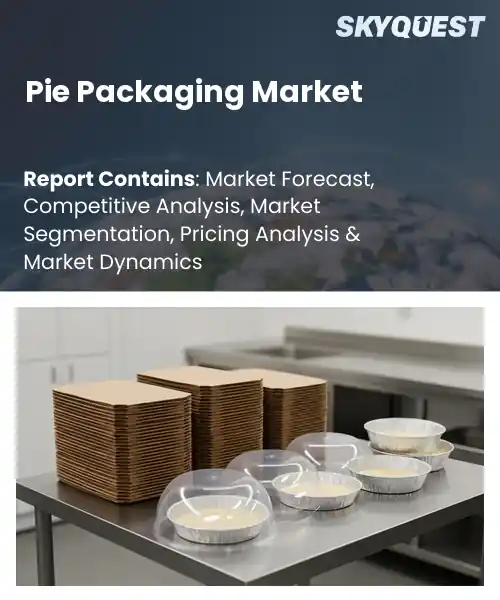
Pie Packaging Market
Report ID: SQMIG25I2058
Report ID: SQMIG25I2058
[email protected]
USA +1 351-333-4748
Report ID:
SQMIG25I2058 |
Region:
Global |
Published Date: February, 2026
Pages:
157
|Tables:
180
|Figures:
79


Global Pie Packaging Market size was valued at USD 1.07 Billion in 2024 and is poised to grow from USD 1.24 Billion in 2025 to USD 4.13 Billion by 2033, growing at a CAGR of 16.2% during the forecast period (2026-2033).
Increasing demand for convenience foods, increasing need for extended shelf life, and growing emphasis on sustainable packaging solutions are forecasted to boost the sales of pie packaging products across the study period.
The advancement of packaging materials from simple cardboard boxes to modern, eco-friendly materials has greatly improved the protection, transportation, and display of the products. Moreover, increasing awareness among consumers about sustainable living and the implementation of environmental regulations are pushing companies to use biodegradable trays, recyclable cardboard, and mono-material films, thereby increasing brand value and the circularity of the packaging materials. The increasing focus on reducing food waste and improving product freshness is also promoting the adoption of advanced packaging solutions such as barrier films, molded pulp trays, and recyclable containers. Growing demand for convenience and longer shelf life among consumers coupled with expansion of retail and foodservice sectors are expected to primarily drive pie packaging market growth.
On the contrary, high costs of sustainable packaging materials, technical challenges in ensuring durability and freshness, regulatory compliance issues, and limited standardization are anticipated to slow down pie packaging market penetration over the coming years.
How is AI-driven Automation Improving Production Efficiency for Pie Packaging Companies?
The pie packaging market is witnessing an improvement in production efficiency through the use of AI-driven automation technologies, which are providing greater accuracy and minimizing manual handling. Computer vision is being used for inspecting the shape and quality of the pies, and robots are being used for handling the products, which are fragile in nature. Machine learning is also being used for adjusting the packaging formats, which is providing greater flexibility. The market is known for handling a variety of products and experiencing a surge in demand.
In February 2026, Amcor expanded its shrink film capabilities and introduced AI-enabled equipment that automates bag sizing and removes manual steps. This helps pie manufacturers speed up changeovers, reduce waste, and maintain higher uptime through smart sensors and adaptive controls.
Market snapshot - (2026-2033)
Global Market Size
USD 1.07 Billion
Largest Segment
Boxes & Cartons
Fastest Growth
Custom / Branded Packaging
Growth Rate
16.2% CAGR
To get more insights on this market click here to Request a Free Sample Report
Global pie packaging market is segmented by product type, material, packaging style, application, end-use industry, distribution channel, and region. Based on product type, the market is segmented into trays & inserts, boxes & cartons, wraps & films, sealed & tamper-evident packaging, and custom / branded packaging. Based on material, the market is segmented into paper & paperboard, plastic, biodegradable / compostable materials, aluminum & foil laminates, and other materials. Based on packaging style, the market is segmented into rigid packaging, flexible packaging, and semi-rigid packaging.
Based on application, the market is segmented into retail bakery packaging, food service / quick service restaurants, e-commerce / direct-to-consumer, bulk / wholesale packaging, and custom promotional packaging. Based on end-use industry, the market is segmented into retail & grocery, food & beverage manufacturers, catering & hospitality, online food delivery, and others. Based on distribution channel, the market is segmented into Direct OEM sales, distributors & dealers, retail / supermarkets, and online sales. Based on region, the market is segmented into North America, Europe, Asia Pacific, Latin America and Middle East & Africa.
The boxes & cartons segment is slated to hold the highest global pie packaging market share in the future. Combination of structural protection with expansive branding surface that preserves pie integrity is helping this segment hold sway over others. This rigid design also reduces product damage, minimizes waste, and enables stacking, as well as high-quality printing that transmits freshness signals. As retailers and suppliers focus on presentation and operational speed, the boxes satisfy packing speed and presentation needs, thereby confirming supplier selection and investment in carton manufacturing capabilities.
However, sealed & tamper evident packaging is the most rapidly expanding segment as per this pie packaging industry analysis. Increasing food safety expectations and direct to consumer deliveries are helping create new business scope. Innovations in easy peel seals and freshness indicators drive adoption by bakeries and e-commerce merchants seeking new routes to market and justifying investment in tamper evident technologies.
The biodegradable / compostable materials segment is slated to spearhead the global pie packaging market revenue generation. Rising consumer and buyer emphasis on sustainability drives formulators and packers to replace traditional plastics thereby cementing the leadership of this segment. Compostable substrates improve the green credentials of the packaging while providing marketing messages that influence retailer selection. In response, suppliers develop more effective barrier coatings and logistics to meet the demand, which drives manufacturers to innovate their product offerings and invest in compostable processing technologies, creating a virtuous cycle of adoption for the pie packaging value chain.
However, paper & paperboard is also being recognized as the material that is growing most rapidly, driven by advances in grease-resistant coatings and printable surfaces for premium branding. Barrier enhancements and lightweighting make paper a more appealing material for pies, which is unlocking opportunities for bakers and retailers looking for recyclable solutions.
To get detailed segments analysis, Request a Free Sample Report
Mature supply chains, advanced manufacturing capabilities, and a strong blend of retail and foodservice demand helps this region emerge as a global leader. Abundance of capable suppliers gives rise to rapid innovation in new materials and technologies being introduced into the marketplace through the continual introduction of new packaging materials, barrier technology, automation, etc., that all enhance the shelf life of the products they package and increase production rates.
Furthermore, the increasing trend toward consumer convenience (ready-to-eat and chilled products) has seen an increase in the variation of formats available to consumers, while investment in recycling and environmentally sustainable materials has created an equilibrium between consumer expectations and performance expectations. In addition, due to the increasing regulatory scrutiny placed on grocery items related to food safety and labeling, many suppliers have increased their usage of compliant, high-quality packaging solutions.
Large scale manufacturing, diverse format demand, and rapid adoption of automation and sustainable materials are shaping pie packaging demand in the United States. Strong private label and customization activities result in increased demand for flexible and rigid products. Strong distribution infrastructure supports cold chain and omnichannel capabilities and facilitates collaborative innovation between suppliers and brands. Retail chains and foodservice operators seek convenience-oriented formats and adhere to high safety standards.
Presence of a resilient manufacturing base, close ties with regional suppliers, and a consumer focus on freshness and sustainability shape pie packaging sales in Canada. Small-scale artisanal manufacturers and large-scale foodservice businesses require packaging that maintains freshness while providing attractive merchandising opportunities. Innovation investments and partnerships with packaging converters can provide the necessary supply base and responsiveness to consumer trends.
Surge in preference for sustainable, high performing solutions, and progressive regulatory and consumer expectations around circularity shape pie packaging adoption in Europe. Premium bakery, chilled convenience, and on-the-go consumption are also creating a need for differentiated solutions that deliver design, barrier, and overall packaging performance. Cross-country trade, retail, and a thriving artisan market are also driving the need for flexible formats and innovative packaging solutions for traceability and consumer engagement.
New technologies in advanced converters and packaging solutions are opening avenues for new processes, and the food manufacturers are collaborating with them to provide specific solutions for the products. Recyclable and reusable formats are also an area of interest for retailers and brand owners, and this is opening avenues for innovation in the field of materials and lightweight formats for the integrity of the products.
Pie packaging demand in Germany is shaped by a highly developed manufacturing industry and engineering skills for a compliant package. Converter companies and food manufacturers collaborate in the production of recyclable forms and robust formats for freshness and premiumness. Solutions are sought by both retail groups and artisanal bakers to enable automation and visual merchandising. All of these factors allow Germany to emerge as a leading hub for pie packaging manufacturing in Europe.
High consumer demand for convenience and sustainable options is primarily augmenting sales of pie packaging across the United Kingdom. Joint efforts of converters, materials scientists, and brands facilitate the pace of pilot projects and scale-up of innovative packaging solutions for different distribution channels. Retailers and foodservice companies are driving demand for recyclable, lightweight structures that work well in chilled and delivery models. Experimentation of companies with branding-oriented, tamper-evident, and portion control packaging also creates new business scope.
Robust artisanal baking traditions and a growing emphasis on premium presentation and sustainability shapes pie packaging adoption in France. Collaborations between design studios and local manufacturers provide barrier solutions, putting France on the map for unique pie packaging solutions. Retailers require stylish recyclable packaging that excels in chilled environments for merchandising opportunities. Bakers and specialty food manufacturers require bespoke packaging that highlights origin while maintaining texture and aroma integrity.
The Asia Pacific region is witnessing rapid modernization of manufacturing capabilities, increased collaboration with global suppliers, and consumer demand for convenience foods, which is driving pie packaging sales. Regional converters are investing in automation and flexible equipment that can accommodate a variety of formats for chilled, frozen, and ready-to-eat pies, which are popular in the region according to taste preferences. The growth of modern retail and online grocery platforms in the region creates a need for packaging solutions that can accommodate multiple platforms, as well as meeting local regulations and expectations for sustainable solutions. Material developers and engineers are adapting barrier materials and recyclable materials for warm climates and transportation conditions.
Pie packaging demand in Japan is slated to be governed by emphasis on precision, convenience and presentation in packaging. Developers are working on high barrier films, graphics, and compact packaging structures, especially for chilled and ambient formats. Convenience store and bakery segments require compact formats, retention of texture and aroma, and easy consumption. Strong cooperation between raw material suppliers, converters, and food manufacturers also boosts scope of innovation.
High demand for innovation in format design, quality printing, and convenience packaging are driving pie packaging sales in South Korea. Suppliers are working on space-saving trays, inserts, and tamper-evident solutions to support branding and portion control. Food service chains and online platforms drive demand for secure and attractive packaging solutions that maintain chilled pies during transport.
To know more about the market opportunities by region and country, click here to
Buy The Complete Report
Rising Demand For Convenience
High consumer demand for ready-to-eat and single-portion food products that fit busy lifestyles, is primarily boosting pie packaging market outlook. Pie packaging allows for better freshness preservation, supports easy handling, and enables attractive presentation. Packaging solutions that facilitate easy transport, stacking, and consumption of the product have encouraged retailers to increase the variety of the product, thus enhancing variety, which is a direct contributor to market growth through increased distribution and variety of the product.
Expansion Of Foodservice And Retail
With the expansion of foodservice outlets and the changing face of retail formats, the need for convenient and portioned desserts drives the pie packaging market to develop packaging solutions for the needs of various outlets. With the increasing need for cafés, bakeries, and delivery services to source reliable pie packaging for the maintenance of quality during delivery and display, manufacturers develop packaging solutions for the needs of various outlets, thus promoting the pie packaging market. With the improvement in channel penetration, the visibility of packaged pies drives the pie packaging market to grow by promoting the need for packaging innovation.
Rising Costs Of Packaging Materials
Rising costs related to raw materials and substrates for packaging pies may limit the ability of the manufacturer to maintain their prices while keeping the prices at retail acceptable. Producers may also hesitate to invest in new products with better performance or sustainable products due to increased raw material costs, which may limit the introduction of new products or varieties. This may limit the growth of the market due to the negative impact on new product introductions and the varieties of packaged products available for sale.
Stringent Environmental Regulations
Tighter regulations on environmental factors like package materials, recyclability, and waste disposal require manufacturers to change their designs and materials. This creates uncertainty for manufacturers and may hinder new product introductions. The need to comply with different regional regulations makes things even more complex for manufacturers. This may require manufacturers to retool their manufacturing lines and/or find new suppliers. This is a challenge for manufacturers. This may hinder new product introductions and restrain market growth by creating operational challenges for new and different types of packaging.
Request Free Customization of this report to help us to meet your business objectives.
Competitive intensity in the global pie packaging market is shaped by sustainability mandates, consolidation, and platform partnerships. Firms pursue acquisitions to secure compostable technology, exemplified by Zume’s acquisition of Pivot. Strategic supply partnerships with foodservice platforms win bakery distribution, as seen with Zerocircle and Swiggy. Material innovation, such as Mushroom Material’s mycelium pellets to replace polystyrene, is a key competitive lever.
SkyQuest’s ABIRAW (Advanced Business Intelligence, Research & Analysis Wing) is our Business Information Services team that Collects, Collates, Correlates, and Analyses the Data collected by means of Primary Exploratory Research backed by robust Secondary Desk research.
As per SkyQuest analysis, rising demand for convenience foods and growing focus on automation and efficiency in packaging operations are anticipated to drive the demand for pie packaging market going forward. However, high costs of advanced packaging technologies and challenges in maintaining consistency and quality are slated to slow down the sales of pie packaging through 2033. North America is slated to spearhead the demand for pie packaging market owing to the strong presence of large-scale food manufacturers, advanced retail infrastructure, and early adoption of automation technologies. Development of AI-driven packaging systems, integration of smart sensors and robotics, and advancements in adaptive packaging formats are anticipated to be key trends driving the pie packaging sector over the coming years.
| Report Metric | Details |
|---|---|
| Market size value in 2024 | USD 1.07 Billion |
| Market size value in 2033 | USD 4.13 Billion |
| Growth Rate | 16.2% |
| Base year | 2024 |
| Forecast period | (2026-2033) |
| Forecast Unit (Value) | USD Billion |
| Segments covered |
|
| Regions covered | North America (US, Canada), Europe (Germany, France, United Kingdom, Italy, Spain, Rest of Europe), Asia Pacific (China, India, Japan, Rest of Asia-Pacific), Latin America (Brazil, Rest of Latin America), Middle East & Africa (South Africa, GCC Countries, Rest of MEA) |
| Companies covered |
|
| Customization scope | Free report customization with purchase. Customization includes:-
|
To get a free trial access to our platform which is a one stop solution for all your data requirements for quicker decision making. This platform allows you to compare markets, competitors who are prominent in the market, and mega trends that are influencing the dynamics in the market. Also, get access to detailed SkyQuest exclusive matrix.
Table Of Content
Executive Summary
Market overview
Parent Market Analysis
Market overview
Market size
KEY MARKET INSIGHTS
COVID IMPACT
MARKET DYNAMICS & OUTLOOK
Market Size by Region
KEY COMPANY PROFILES
Methodology
For the Pie Packaging Market, our research methodology involved a mixture of primary and secondary data sources. Key steps involved in the research process are listed below:
1. Information Procurement: This stage involved the procurement of Market data or related information via primary and secondary sources. The various secondary sources used included various company websites, annual reports, trade databases, and paid databases such as Hoover's, Bloomberg Business, Factiva, and Avention. Our team did 45 primary interactions Globally which included several stakeholders such as manufacturers, customers, key opinion leaders, etc. Overall, information procurement was one of the most extensive stages in our research process.
2. Information Analysis: This step involved triangulation of data through bottom-up and top-down approaches to estimate and validate the total size and future estimate of the Pie Packaging Market.
3. Report Formulation: The final step entailed the placement of data points in appropriate Market spaces in an attempt to deduce viable conclusions.
4. Validation & Publishing: Validation is the most important step in the process. Validation & re-validation via an intricately designed process helped us finalize data points to be used for final calculations. The final Market estimates and forecasts were then aligned and sent to our panel of industry experts for validation of data. Once the validation was done the report was sent to our Quality Assurance team to ensure adherence to style guides, consistency & design.
Analyst Support
Customization Options
With the given market data, our dedicated team of analysts can offer you the following customization options are available for the Pie Packaging Market:
Product Analysis: Product matrix, which offers a detailed comparison of the product portfolio of companies.
Regional Analysis: Further analysis of the Pie Packaging Market for additional countries.
Competitive Analysis: Detailed analysis and profiling of additional Market players & comparative analysis of competitive products.
Go to Market Strategy: Find the high-growth channels to invest your marketing efforts and increase your customer base.
Innovation Mapping: Identify racial solutions and innovation, connected to deep ecosystems of innovators, start-ups, academics, and strategic partners.
Category Intelligence: Customized intelligence that is relevant to their supply Markets will enable them to make smarter sourcing decisions and improve their category management.
Public Company Transcript Analysis: To improve the investment performance by generating new alpha and making better-informed decisions.
Social Media Listening: To analyze the conversations and trends happening not just around your brand, but around your industry as a whole, and use those insights to make better Marketing decisions.
REQUEST FOR SAMPLE
Global Pie Packaging Market size was valued at USD 1.07 Billion in 2024 and is poised to grow from USD 1.24 Billion in 2025 to USD 4.13 Billion by 2033, growing at a CAGR of 16.2% during the forecast period (2026-2033).
Competitive intensity in the global pie packaging market is shaped by sustainability mandates, consolidation and platform partnerships. Firms pursue acquisitions to secure compostable technology, exemplified by Zume’s acquisition of Pivot. Strategic supply partnerships with foodservice platforms win bakery distribution, as seen with Zerocircle and Swiggy. Material innovation, such as Mushroom Material’s mycelium pellets to replace polystyrene, is a key competitive lever. 'Eco-Products Inc.', 'International Paper Company', 'Packtech Group', 'Amcor Flexibles', 'WestRock Company', 'Crown Holdings', 'Sonoco Products Company', 'Smurfit Kappa Group', 'Sealed Air Corporation', 'Polypak Packaging', 'Berry Global, Inc.', 'Novolex Holdings, LLC', 'Constantia Flexibles', 'Grafix Solutions', 'ProAmpac', 'Printpack Inc.', 'Clearpack Group', 'Landaal Packaging Systems', 'Huhtamaki Group', 'Thomas Packaging, LLC'
Consumers increasingly seek ready-to-eat and single-portion desserts that fit busy lifestyles, which prompts manufacturers and foodservice operators to favor pie packaging that preserves freshness, supports easy handling, and enables attractive presentation. Packaging formats that simplify transport, stacking, and on-the-go consumption encourage retailers to stock a wider assortment and drive product variety, while suppliers innovate materials and designs to meet convenience needs. The focus on convenience thus expands distribution channels and product launches, directly supporting market growth through broader adoption and higher turnover of packaged pie products.
Customization And Personalization Demand: Manufacturers and retailers are prioritizing packaging that supports differentiated product positioning, seasonal promotions, and limited editions to engage consumers emotionally. Flexible production runs, lead times, and modular design approaches enable bespoke graphics, portion sizes, and labeling that resonate with niche segments and culinary trends. Investment in agile manufacturing and closer collaboration with brand teams drives packaging that reinforces brand storytelling while protecting product integrity. This trend elevates demand for adaptable materials and printing technologies that balance visual appeal with practicality.
North America is Dominating the Global Pie Packaging Market. Mature supply chains, advanced manufacturing capabilities, and a strong blend of retail and foodservice demand helps this region emerge as a global leader.
Want to customize this report? This report can be personalized according to your needs. Our analysts and industry experts will work directly with you to understand your requirements and provide you with customized data in a short amount of time. We offer $1000 worth of FREE customization at the time of purchase.
Feedback From Our Clients


 USA (+1) 351-333-4748