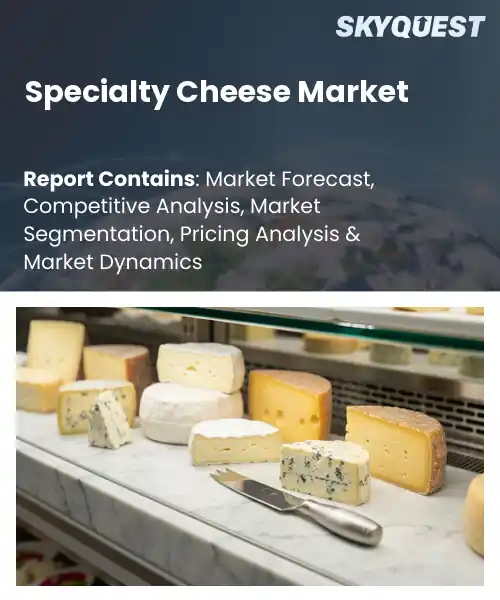
Specialty Cheese Market
Report ID: SQMIG30I2879
Report ID: SQMIG30I2879
[email protected]
USA +1 351-333-4748
Report ID:
SQMIG30I2879 |
Region:
Global |
Published Date: February, 2026
Pages:
157
|Tables:
117
|Figures:
77


Global Specialty Cheese Market size was valued at USD 37.9 Billion in 2024 and is poised to grow from USD 39.68 Billion in 2025 to USD 57.3 Billion by 2033, growing at a CAGR of 4.7% during the forecast period (2026-2033).
The specialty cheese market consists of artisanal, aged, and region-specific cheeses with premium pricing. The reason for this premium price is that consumers are looking for authenticity, provenance and culinary experience. Higher margin opportunities will be created by foodservice and producers for differentiation & that has transitioned from supplying local farms to having a globally traded category due to gastronomic tourism and culinary trends.
There are European protected names like Parmigiano Reggiano and Manchego that signal quality, while an American artisan renaissance increased small batch production. Specialty retailers such as Murray’s and Eataly have increased their presence with improved cold chain logistics and increased online sales, which have improved distribution, expanded access globally, and set the stage for further market growth.
A key driver of this market is the incorporation of cold chain logistics with digital commerce because retailers benefit from being able to sell high margin small batch cheeses. When cold chain logistics and digital commerce work together, it reduces spoilage by providing a reliable refrigeration and temperature-controlled transport arrangement and allows an online storefront for producers to reach new consumers. Importers and retailers have listed niche specialty products on their shelves, providing room for innovative product development in aging, hybridizing flavours, and collaborative pairing with craft breweries and wineries. Examples would include meal kit providers featuring truffled Pecorino, seasonally subscription boxes provided by specialty providers, and new wine pairing menus introduced by restaurants.
How is Blockchain Improving Traceability In The Specialty Cheese Market?
Blockchain improves traceability in specialty cheese by establishing an unalterable record of the cheese's origin and its subsequent handling by linking farms to creameries, aging rooms, and retailers. Some key features are provenance records that cannot be altered after they are written, time-stamped quality checks of when the cheese was produced; and the ability to associate test/measurement data from laboratories and/or sensors to specific batches of cheese. There is strong interest in specialty cheese producers that desire to protect their designation of origin and restore consumer confidence.
QR code–enabled provenance labels, combined with integrated sensor data, verify both cold chain storage conditions and the artisanal origin of the cheese. This enhances the rapidity of recall actions and increases consumer confidence in purchasing specialty cheeses. Since August 2023, producers of Parmigiano Reggiano have been embedding cost-effective microchips into Parmigiano Reggiano cheese. These chips have a link to blockchain-protected records of the cheese's origin and handling, as well as aiding in the reduction of fraud by providing a quick and easy process for buyers to confirm their purchases.
Market snapshot - 2026-2033
Global Market Size
USD 37.9 Billion
Largest Segment
Cheese Type
Fastest Growth
Cheese Form
Growth Rate
4.7% CAGR
To get more insights on this market click here to Request a Free Sample Report
The specialty cheese market is segmented into product, source, application, distribution channel and region. Based on product, the market is segmented into cheese type and cheese form. Based on source, the market is segmented into goat milk, whole cow milk, skimmed cow milk, sheep milk and others. Based on application, the market is segmented into food service sector, households and industrial. Based on distribution channel, the market is segmented into online and offline. Based on region, the market is segmented into North America, Europe, Asia Pacific, Latin America and Middle East & Africa.
As per specialty cheese market outlook, the goat milk segment is leading this category due to its unique, tangy, complex tastes allowing differentiation among the artisanal cheese categories. Producers of artisanal cheese have chosen to use Goat Milk because their herd sizes are typically smaller and can vary their ageing methods, permitting them to experiment with various textures and flavour combinations. The high perception of authenticity and the premium quality associated with these products allows chefs and specialty retailers to have high visibility on store shelves and to provide additional value to their products and increase the prestige of their brands.
As per specialty cheese market analysis, the sheep milk segment is emerging as the fastest growing segment, as the rich creaminess and unique flavour of this type of cheese satisfies the growing consumer's desire for an indulgent artisanal product. Chefs and specialty retailers are beginning to incorporate these types of cheese products because they have a completely different texture than cow milk and are aged exceptionally well. With innovation and curiosity by consumers, there is a lot of room for premium product development and opportunity for sheep milk cheese.
Block segment leads with specialty cheese market share because whole blocks and wheels preserve artisanal integrity and allow producers and retailers to showcase provenance and aging narratives that resonate with specialty buyers. The flexibility of portioning and customization is an added benefit of this format for specialty chefs, retailers, and consumers, providing margin control and storytelling that increases perceived value. With the increase in supply chain management and the extended shelf life of whole blocks, the reduction of processing loss and support for traditional aging practices provide ongoing demand for specialty products and retail experiences.
As per specialty cheese market forecast, grated form is witnessing the strongest growth momentum because convenience driven consumption and ready to use formats align with modern culinary practices. New packaging and preservation innovations are providing additional uses within both foodservice and households, with the incorporation of prepared meals creating many additional points of entry for specialty products and accelerating commercialization for manufacturers.
To get detailed segments analysis, Request a Free Sample Report
The specialty cheese industry is dominated by Europe, owing to the regions' historical roots in dairying, comprehensive regulations, and a high demand for higher-quality, artisanal specialty cheese products. Europe also has a number of advanced dairy farming techniques, an extensive cold-chain logistics system, and continually develops new flavor and processing techniques. The combination of strong domestic consumption and a large demand for exports continues to drive the market for specialty cheeses, and a growing interest in specialty, organic, and natural food products helps to sustain Europe's leadership role in the specialty cheese category
The specialty cheese market in Germany is characterized by its rich dairy heritage, a large number of artisanal cheese makers, and a high level of consumer appreciation for local specialty cheeses. In comparison to other countries, both retailers and specialty stores emphasize the quality and origin of the cheeses sold in their stores, which supports the growth of the cheese businesses as well as the variety of cheeses available. Local cheese producers are also well recognized as a result of consistent culinary training in local schools, food publications and television shows that feature them as their subject.
Finally, due to the high reliability of logistics and cold chain distribution, premium food service will have access to send these cheese products within Germany, the EU and around the world, as long as the regulatory system allows for traceability and complies with the standards in Germany and the EU.
As per specialty cheese market regional outlook, United Kingdom is experiencing a market supported by the vibrant artisan community, many innovative producers using farmstead techniques, and culinary arts activities that continue to evolve throughout the retail and hospitality industries. Specialty cheese retailers and farmers' markets provide opportunities to produce unique products with experimental combinations while independent cheesemakers partner with chefs to expand their customer base for cheese and other products linked to cheesemaking.
The existence of protected heritage varieties and the evolution of the consumer palate support premium pricing and product positioning. The availability of efficient distribution channels and industry marketing initiatives make specialty cheeses accessible to consumers located in metropolitan and regional areas who seek cheese products that have an identifiable origin.
As per specialty cheese industry analysis, France is home to a rich legacy of regional cheesemaking traditions and protected appellations that provide both domestic and international prestige for the French market. Artisan cooperatives and small-scale farms focus on producing products that reflect the terroir and natural aging processes, appealing to consumers who seek authentic specialty cheeses. The large number of specialty cheese retailers and food service establishments providing specialty cheeses allows consumers to discover and savor premium quality specialty and artisanal cheeses. Producer promotional initiatives, in collaboration with culinary schools and festival organizations, assist in maintaining strong cultural relevance and generating excitement about the diverse range of craft-style cheese varieties.
Specialty cheese has grown quickly in North America due to new cravings from consumers, increased excitement about artisanal and farmstead cheeses, and more varied types of retail that sell a variety of specialty cheeses. Culinary specialty cheese market trends emphasizing food pairing, local sourcing, and an experience-based dining experience drive customers to buy from both food service and specialty retailers. Smaller producers invest in producing premium quality while maintaining their artisanal manufacturing techniques, by investing in small scale production capabilities, ageing equipment, and safe food handling procedures.
The specialty cheese market in the United States is driven by consumers looking for different types of specialty cheeses. Many of these cheesemakers have established a farm to table narrative with their cheesemaking due to the growth of craft cheesemaking farms. By working with chefs, craft cheesemakers are able to develop new types of cheeses and flavours. Specialty retailers and grocery store networks help to promote the discovery of new specialty cheeses. Retailers are also increasing their credibility with consumers through better retail distribution and the establishment of good standards for cheese ageing and safe food handling.
As per specialty cheese market regional forecast, Canada market is made up of a strong artisanal movement, diverse sources for dairy, and strong support to Canada’s farmstead cheesemakers via cooperative networks and specialty retailers. The partnerships between cheese producers and culinary experts have created new flavour pairings and seasonal offerings. Government quality certification programs for cheese and marketing support help to establish a reputation for Canadian specialty cheeses. Also. distribution of Canadian specialty cheeses through urban specialty cheese mongers and events helps improve product visibility.
Asia Pacific's specialty cheese market is maturing as a result of a convergence of changes in dietary patterns, increasing culinary sophistication, and continued investments by domestic and international manufacturers. As consumers develop their culinary skills, they are exposed to different types of cheese through urbanization and interest in Western and fusion cuisines, leading to increased exposure to new types of cheese. At the same time, as local manufacturers create new formulations based on the tastes of local consumers, there will be an increasing number of specialty cheeses available to retail consumers due to improved cold-chain logistics, modern retail formats, and an increase in specialty foodservice operations.
The specialty cheese market is expanding in Japan because consumers have developed sophisticated palates, appreciated the culinary attributes of texture and subtle flavor, and collaborated with domestic dairies and international cheesemakers. Seasonal varieties of artisan cheeses are available at grocery stores and specialty grocery stores, while fine dining establishments feature regional cheese pairings. Artisan cheese makers modify their recipes based on the properties of the local milk and offer milder rind styles that meet consumer tastes. Taste testing and media coverage will foster a greater understanding and acceptance of the various categories of artisan cheese.
The specialty cheese market is developing in South Korea due to consumers growing culinary interest in dining culture, and an increased desire to purchase artisanal produced cheese, whether imported or domestically produced. Urban specialty grocery stores and themed markets continue to showcase the range of niche artisan cheeses and help consumers with cheese pairing. The range of specialty cheeses available for retail consumers in South Korea will focus on hybrid cheesemaking and types of cheeses with a shorter shelf-life that are suited to the tastes of local consumers.
To know more about the market opportunities by region and country, click here to
Buy The Complete Report
Rising Demand for Artisanal Varieties
Online and Retail Channel Expansion
Supply Chain and Ingredient Constraints
Regulatory and Compliance Barriers
Request Free Customization of this report to help us to meet your business objectives.
The global specialty cheese industry is competitive, primarily through consolidation activity and food-tech partnerships. Companies are working toward developing differentiated textures and using sustainable ingredients. Major manufacturers are using mergers and acquisitions to enter niche product ranges (for instance, Emmi’s purchase of Athenos) while at the same time partnering with precision fermentation providers to develop co-created uses of animal-free cheese products. Emerging food-tech startups are leveraging fermentation techniques to provide comparable-tasting products while proving more efficient supply chain operations.
Plant-Based Artisan Expansion
Sustainability Driven Differentiation
SkyQuest’s ABIRAW (Advanced Business Intelligence, Research & Analysis Wing) is our Business Information Services team that Collects, Collates, Correlates, and Analyses the Data collected by means of Primary Exploratory Research backed by robust Secondary Desk research.
As per SkyQuest analysis, the global specialty cheese market is poised for steady premiumization driven by consumer demand for artisanal varieties and strengthened by improved cold chain logistics and digital commerce that expand reach and reduce spoilage. A key driver is rising consumer appetite for provenance and sensory variety, while a second driver is the rapid expansion of online and modern retail channels enabling broader distribution. A notable restraint remains supply chain and ingredient constraints that limit scaling and consistent output. Europe continues to dominate the market given its deep artisanal heritage, and the goat milk segment leads due to its distinctive flavor profiles and strong artisanal positioning.
| Report Metric | Details |
|---|---|
| Market size value in 2024 | USD 37.9 Billion |
| Market size value in 2033 | USD 57.3 Billion |
| Growth Rate | 4.7% |
| Base year | 2024 |
| Forecast period | 2026-2033 |
| Forecast Unit (Value) | USD Billion |
| Segments covered |
|
| Regions covered | North America (US, Canada), Europe (Germany, France, United Kingdom, Italy, Spain, Rest of Europe), Asia Pacific (China, India, Japan, Rest of Asia-Pacific), Latin America (Brazil, Rest of Latin America), Middle East & Africa (South Africa, GCC Countries, Rest of MEA) |
| Companies covered |
|
| Customization scope | Free report customization with purchase. Customization includes:-
|
To get a free trial access to our platform which is a one stop solution for all your data requirements for quicker decision making. This platform allows you to compare markets, competitors who are prominent in the market, and mega trends that are influencing the dynamics in the market. Also, get access to detailed SkyQuest exclusive matrix.
Table Of Content
Executive Summary
Market overview
Parent Market Analysis
Market overview
Market size
KEY MARKET INSIGHTS
COVID IMPACT
MARKET DYNAMICS & OUTLOOK
Market Size by Region
KEY COMPANY PROFILES
Methodology
For the Specialty Cheese Market, our research methodology involved a mixture of primary and secondary data sources. Key steps involved in the research process are listed below:
1. Information Procurement: This stage involved the procurement of Market data or related information via primary and secondary sources. The various secondary sources used included various company websites, annual reports, trade databases, and paid databases such as Hoover's, Bloomberg Business, Factiva, and Avention. Our team did 45 primary interactions Globally which included several stakeholders such as manufacturers, customers, key opinion leaders, etc. Overall, information procurement was one of the most extensive stages in our research process.
2. Information Analysis: This step involved triangulation of data through bottom-up and top-down approaches to estimate and validate the total size and future estimate of the Specialty Cheese Market.
3. Report Formulation: The final step entailed the placement of data points in appropriate Market spaces in an attempt to deduce viable conclusions.
4. Validation & Publishing: Validation is the most important step in the process. Validation & re-validation via an intricately designed process helped us finalize data points to be used for final calculations. The final Market estimates and forecasts were then aligned and sent to our panel of industry experts for validation of data. Once the validation was done the report was sent to our Quality Assurance team to ensure adherence to style guides, consistency & design.
Analyst Support
Customization Options
With the given market data, our dedicated team of analysts can offer you the following customization options are available for the Specialty Cheese Market:
Product Analysis: Product matrix, which offers a detailed comparison of the product portfolio of companies.
Regional Analysis: Further analysis of the Specialty Cheese Market for additional countries.
Competitive Analysis: Detailed analysis and profiling of additional Market players & comparative analysis of competitive products.
Go to Market Strategy: Find the high-growth channels to invest your marketing efforts and increase your customer base.
Innovation Mapping: Identify racial solutions and innovation, connected to deep ecosystems of innovators, start-ups, academics, and strategic partners.
Category Intelligence: Customized intelligence that is relevant to their supply Markets will enable them to make smarter sourcing decisions and improve their category management.
Public Company Transcript Analysis: To improve the investment performance by generating new alpha and making better-informed decisions.
Social Media Listening: To analyze the conversations and trends happening not just around your brand, but around your industry as a whole, and use those insights to make better Marketing decisions.
REQUEST FOR SAMPLE
Specialty Cheese Market is growing at a 4.7% CAGR, reaching USD 57.3 Billion by 2033 due to increasing consumer preference for gourmet and organic cheese.
Key vendors in the Specialty Cheese Market include Lactalis Group, Saputo Inc., Arla Foods, Fonterra Co-operative Group, and Bel Group, along with Emmi Group, Sargento Foods, and Groupe Savencia, competing through premium offerings, innovation, and strong global distribution networks.
The key driver of the Specialty Cheese Market is the rising consumer demand for premium, artisanal, and gourmet food products, supported by evolving taste preferences, higher disposable incomes, and increasing interest in unique flavors and high-quality dairy products.
The key market trend in the Specialty Cheese Market is the increasing focus on product innovation and flavor diversification, with manufacturers introducing new infused, artisanal, and plant-based cheese varieties to meet evolving consumer preferences for unique, premium, and health-conscious options.
Europe accounted for the largest share in the Specialty Cheese Market, driven by its rich cheese-making heritage, high consumption levels, and strong presence of established artisanal and premium cheese producers.
Want to customize this report? This report can be personalized according to your needs. Our analysts and industry experts will work directly with you to understand your requirements and provide you with customized data in a short amount of time. We offer $1000 worth of FREE customization at the time of purchase.
Feedback From Our Clients


 USA (+1) 351-333-4748